


Reducing energy consumption in the production of cold
Cooling energy is the most important form of energy for keeping operations running, particularly in a summer like this one.
Die Kühlung von Gebäuden, Produktionsbereichen und Rechenzentren entwickelt sich für viele Unternehmen zunehmend zu einem bedeutenden Kostenfaktor. Steigende Außentemperaturen, höhere Anforderungen an den Arbeitskomfort sowie die fortschreitende Digitalisierung sorgen dafür, dass der Energiebedarf für Kälteanwendungen kontinuierlich wächst. Gleichzeitig stehen Unternehmen unter Druck, ihre Energiekosten zu senken und ihre Klimaziele zu erreichen.
It is often underestimated just how much of an impact even small changes to the setpoint temperature can have. Whether in an office building, a production hall or a data centre, every degree of indoor temperature can make a noticeable difference to the energy consumption of its chiller. By planning and managing your cooling strategy intelligently, you can achieve significant savings without compromising on comfort or operational reliability.
In this article, you will learn about the role played by temperature selection, the potential savings offered by modern cooling concepts, and why data centres in particular are now cooled differently than they were just a few years ago, thereby achieving significant savings in cooling energy.
Warum Kühlung in Unternehmen immer wichtiger wird
For a long time, many companies focused primarily on heating. However, cooling is now becoming increasingly important. Reasons for this include climate change, with more frequent heatwaves, rising standards for comfort in the workplace, and the growing use of heat-generating technologies.
Office buildings with large glass surfaces, production facilities with heat-intensive processes and data centres, in particular, require considerable amounts of cooling energy. In some companies, cooling already accounts for a significant proportion of total electricity consumption.
Furthermore, cooling is often powered by electricity. As a result, rising electricity prices have a direct impact on operating costs. At the same time, high electricity consumption increases CO₂ emissions and makes it more difficult to achieve sustainability targets.
Against this background, it becomes clear that energy-efficient cooling is not only a technical issue, but also an economic and strategic one.
Was bringt ein Grad mehr oder weniger? Der Zusammenhang zwischen Temperatur und Energieverbrauch
The key question is: How much energy can actually be saved by adjusting the cooling temperature?
As a general rule, the greater the difference between the indoor and outdoor temperatures, the more energy is required for cooling. Even small changes to the setpoint temperature can therefore have a significant impact on energy consumption.
As a rule of thumb, it is often assumed that raising the cooling temperature by one degree Celsius can reduce the air-conditioning system’s energy consumption by several per cent. The actual saving depends on a number of factors, including the building’s structure, the system’s design, outdoor temperatures and operating hours.
A real-world example: If the room temperature in an office building is raised from 22 °C to 24 °C, many employees will still find this comfortable. At the same time, the energy consumption of the cooling system can be significantly reduced. In this example, cooling energy consumption can be reduced by up to 27 per cent.
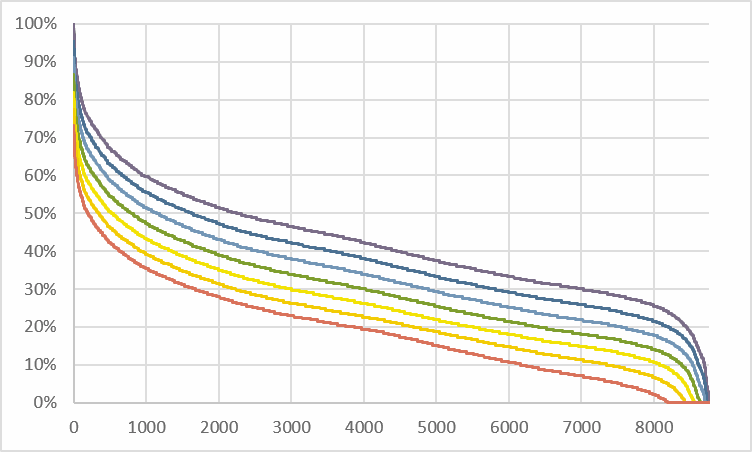
The reason for this is simple: the cooling system does not have to work as hard, the compressors run for shorter periods, and the entire system operates more efficiently. Over the course of a year, this can result in significant cost savings.
The figure above shows the cooling energy required for a server room. The difference in energy consumption between 24°C (shown in red at the bottom) and 18°C (shown in purple at the top) represents a saving of approximately 55 per cent.
That is why it is worth taking a critical look at existing setpoints. Rooms are often cooled to a much lower temperature than is actually necessary.
Choosing the right room temperatures: striking a balance between comfort and energy efficiency
The ideal room temperature is always a balance between comfort, productivity and energy efficiency. In office buildings, temperatures of between 22 °C and 24 °C are often targeted. However, research shows that employees can still work productively even at slightly higher temperatures, provided that air quality and air circulation are adequate.
It is not just the temperature that is crucial here, but the overall indoor climate. Factors such as humidity, sunlight and air velocity have a significant influence on how warm or cool we feel.
Companies should therefore not rely solely on low temperatures, but should instead adopt a holistic approach to comfort. This includes, for example:
- external sun protection
- Shading systems
- optimised ventilation
- needs-based regulation
- Zone-by-zone temperature control
It makes particular sense to consider different areas on a case-by-case basis. Whilst meeting rooms or server rooms may have specific requirements, corridors or storage areas often need to be cooled to a much lesser extent.
Optimising cooling systems: Common mistakes and hidden energy losses
Many refrigeration systems are inefficient not because the technology is outdated, but because the settings have not been optimised.
A common mistake is to set the target temperature unnecessarily low. People often try to be prepared for particularly hot days, which means the system constantly uses more energy than necessary.
Equally problematic are systems that run continuously outside normal hours of use. It is not uncommon for office spaces to be cooled at night, at weekends or on public holidays, even though they are not in use.
Other typical vulnerabilities include:
- Dirty heat exchangers
- faulty sensors
- incorrectly set control parameters
- lack of maintenance
- Inadequate insulation of coolant pipes
Regular system checks can help to identify and rectify such problems at an early stage. This often leads to savings without the need for major investment.
Free cooling and night cooling: making the most of free cooling potential
One particularly interesting way of saving energy is to use what is known as ‘free cooling’.
This method utilises low outdoor temperatures to cool buildings or technical installations without the need for active refrigeration. In Germany in particular, the climatic conditions are suitable for this throughout much of the year.
In night-time cooling, for example, fresh air is circulated through buildings during the cooler hours of the night. The stored heat is dissipated, meaning that less cooling energy is required during the day.
Die Vorteile liegen auf der Hand:
- deutlich geringerer Stromverbrauch
- lower running costs
- less wear and tear on the refrigeration systems
- reduced CO₂ emissions
Data centres and modern office buildings in particular benefit from these concepts, as they often have the necessary infrastructure to make effective use of free cooling.
As a general rule, avoiding heat gain saves on expensive cooling costs.
Cooling in data centres: Why higher temperatures are now actively sought after
Rechenzentren gehören zu den größten Stromverbrauchern vieler Unternehmen. Ein erheblicher Teil dieser Kälteenergie entfällt auf die Kühlung der IT-Systeme.
In the past, the guiding principle was to keep server rooms as cool as possible. Temperatures of 18 to 20 °C were the norm in many places. Today, this approach has changed fundamentally.
Modern server technology is significantly more robust and can operate reliably at higher temperatures. International guidelines now permit significantly higher supply air temperatures than in the past. In some cases, it is recommended that temperatures should not fall below 28°C, which means that servers can operate without active cooling for most of the year, resulting in a massive reduction in cooling energy (see, for example, here)
This results in significant advantages:
- geringerer Energiebedarf der Kühlung
- longer periods of operation for free cooling
- lower running costs
- improved overall energy efficiency
Many operators are therefore gradually raising their temperature limits and analysing the impact on operations. It often becomes apparent that significant savings can be made without compromising the availability of the systems.
Particularly at a time when data centre capacities are growing, this measure is increasingly becoming a key component of the energy efficiency strategy.
New guidelines for data centres: efficiency, temperature management and waste heat recovery
As the importance of data centres grows, so too do the regulatory requirements.
In recent years, various regulations have been introduced in Germany with the aim of improving the energy efficiency of data centres. The focus is particularly on overall energy efficiency, the use of renewable energy sources and the utilisation of waste heat.
For operators, this means that issues such as cooling systems, temperature management and energy monitoring are becoming increasingly important.
The use of waste heat is particularly interesting. Data centres generate large amounts of heat, which until now has often been released into the environment without being utilised. Modern approaches envisage using this heat, for example, to heat buildings or feed it into district heating networks.
As a result, cooling is evolving from being purely an energy consumer to becoming an integral part of integrated energy concepts.
Thinking about cooling and waste heat as a single entity: from a cost factor to a source of energy
The combination of cooling and heat recovery offers particularly significant potential. Every refrigeration system extracts heat from a given area. This heat does not simply disappear, but is released elsewhere. Modern systems can harness this energy in a targeted manner.
Possible applications include:
- Hot water supply
- Heating of office buildings
- Process heat in production
- Einspeisung in Nahwärmenetze
Businesses with simultaneous heating and cooling requirements in particular can benefit from significant synergies. This reduces both heating and cooling costs.
As energy prices rise, this approach is becoming increasingly important from an economic perspective. The use of cooling energy can therefore lead to significant efficiency gains elsewhere.
A comparison of modern cooling systems: Which technology saves the most energy?
Choosing the right cooling technology has a decisive impact on energy consumption for cooling.
Conventional compression cooling systems are widely used and offer high performance. At the same time, there are now numerous alternatives and supplementary systems that can significantly improve efficiency.
These include, amongst other things:
- adiabatic cooling
- natural cooling
- Heat pumps
- Liquid cooling for data centres
- hybrid cooling systems
Which solution is most suitable depends on the specific requirements. There is no one-size-fits-all recommendation. Rather, each system should be considered on a case-by-case basis and tailored to actual needs.
Conclusion: A small change in temperature can have a major impact on energy costs and the carbon footprint
Cooling energy will become increasingly important for businesses in the coming years. This makes it all the more important to consistently capitalise on existing opportunities for savings.
Even adjusting the setpoint temperature by just a few degrees can significantly reduce energy consumption. When combined with optimised control systems, free cooling, modern plant technology and the intelligent use of waste heat, this results in considerable economic and environmental benefits.
Data centres, in particular, illustrate just how much thinking on the subject has changed in recent years: away from aiming for the lowest possible temperatures, and towards intelligent, energy-efficient cooling strategies.
Companies that regularly review and optimise their cooling systems not only reduce their energy costs, but also enhance their competitiveness and sustainability.
This blog post on cooling energy was created with the help of generative AI and has been carefully supplemented and corrected by us. In addition, similar tools were used to carry out SEO optimisation (this ensures that search engines can find this article and rank it highly).